Cut Food Costs With Your POS: Where the Money Leaks (2026)
Your restaurant POS already holds the data to find waste. Use theoretical vs. actual stock, recipe costing, and waste reports to cut food costs.
If you want to cut food costs, you don't need a new spreadsheet — you need to read the data your restaurant POS already collects. Every sale, every recipe, every delivery, and every wasted portion leaves a trace. The restaurants that protect their margins are the ones that turn those traces into weekly decisions.
This guide shows you exactly where food costs leak in a restaurant, and how to use your POS and inventory data to plug each leak — without guesswork.
What "food cost" actually means
Food cost is the price of the ingredients that go into what you sell. It's usually expressed as food cost percentage:
Food cost % = (Cost of ingredients used ÷ Food sales) × 100
Most full-service restaurants aim for a food cost between 28% and 35%. But the headline number hides the real story. What matters is the gap between two figures:
- Theoretical cost — what your recipes say you should have used, based on every item sold.
- Actual cost — what you really used, based on physical inventory counts.
The difference between them is your leak. A well-run kitchen keeps that variance under ~2-3%. Anything more is money walking out the door — and your POS data is how you find out where.
The five places food costs leak
1. Over-portioning
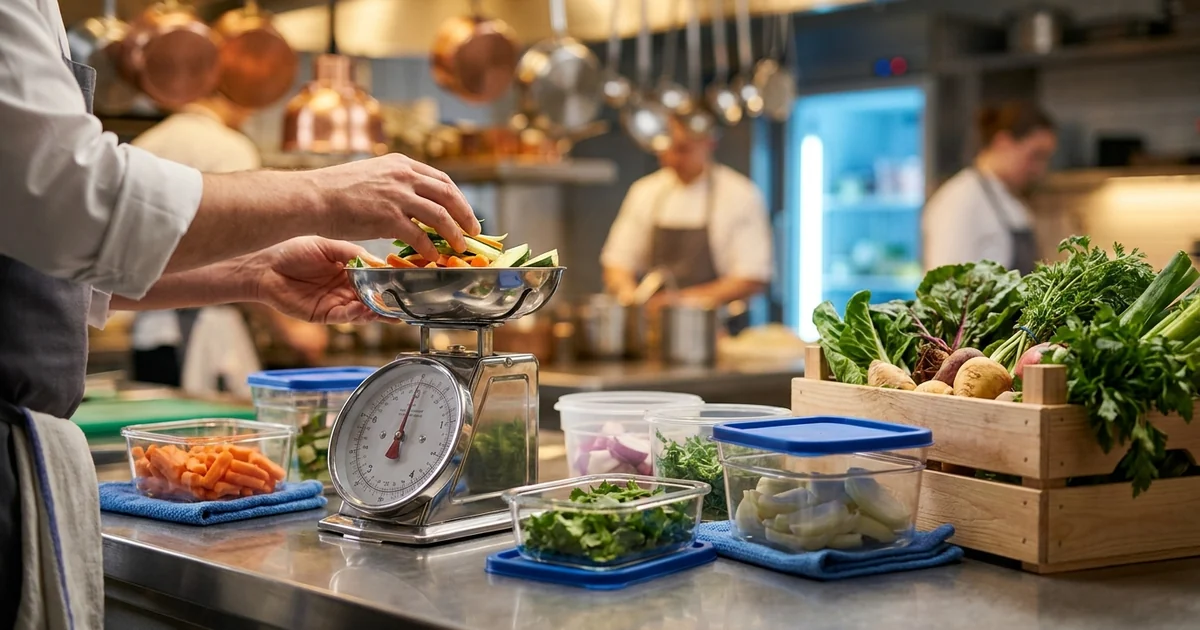
A cook who plates 180g of fries instead of 150g doesn't feel like a problem — until it happens 200 times a day. Without a recipe (technical card) that defines exact quantities, you can't even measure it.
2. Waste and spoilage
Trim, burns, dropped plates, expired stock, and returns all cost real money. If they're not logged with a reason, you can't tell whether the problem is the supplier, the prep station, or the menu.
3. Theft and unrecorded "comps"
Free staff meals, untracked giveaways, and outright theft show up as inventory that's gone with no matching sale. The only way to see it is the variance between theoretical and actual stock.
4. Bad purchasing
Buying too much perishable stock, paying inconsistent prices, or losing track of supplier debts quietly inflates your costs. Purchase invoices in your system make price creep visible.
5. Menu mispricing
Sometimes the leak isn't waste — it's a dish whose ingredient cost has crept up while its menu price stayed frozen. Item-level food cost reports expose the dishes that are losing you money on every order.
How your POS data plugs each leak
This is where a real restaurant POS earns its keep. Here's the workflow that turns raw data into lower costs:
- 1Build recipes (technical cards) for every item. When you sell a margherita pizza, the system should automatically deduct 200g dough, 80g sauce, and 150g mozzarella from stock. This is what makes a theoretical cost possible.
- 2Cost your semi-finished products. Sauces, doughs, and marinades have their own recipes. A good system chains the cost from raw material → semi-finished → final dish, so your costs stay accurate as supplier prices change.
- 3Log every purchase invoice. Track spend by supplier, watch unit prices over time, and manage debts and partial payments. Price creep becomes visible instead of invisible.
- 4Record waste with a reason. Spoilage, breakage, customer return — tagging the reason turns a vague "we lost stock" into "the cold station over-preps salads on Mondays."
- 5Count inventory and read the variance. Compare theoretical stock (what the system expected) against actual stock (what's on the shelf). The gap is your leak, item by item.
- 6Act on the food cost report. Sort dishes by food cost %, find the ones drifting above target, and fix the recipe, the portion, the price, or the supplier.
A simple weekly food-cost routine
You don't need to do everything every day. A tight weekly rhythm beats an occasional deep audit:
- Daily: enter purchase invoices and log waste as it happens.
- Weekly: count your highest-value and fastest-moving items (meat, cheese, alcohol), check the theoretical-vs-actual variance, and review the top 10 dishes by food cost %.
- Monthly: do a full count, recalculate your overall food cost %, and re-price or re-engineer any dish that's consistently over target.
How Clopos helps
Clopos is built around exactly this loop. Its inventory and cost-control tools let you:
- Auto-deduct stock on every sale from technical cards, including multi-level semi-finished products.
- Track waste with reasons so spoilage and over-prep are visible.
- Manage suppliers and purchase invoices, including debts and partial payments.
- Run counts and movement reports — every in, out, transfer, and write-off for any ingredient over any period.
- See item-level food cost so you know which dishes make money and which quietly lose it.
Food cost is only half of your biggest controllable expense. The other half is labor — and together they make up your prime cost. See Restaurant prime cost explained for how to keep the combined number under control. For kitchen-side waste, a Kitchen Display System cuts ticket errors and re-fires that quietly burn product.
Frequently asked questions
What is a good food cost percentage for a restaurant?+
Most full-service restaurants target 28-35%, while some quick-service and pizza concepts run lower. The right number depends on your menu and market — what matters more is keeping the gap between your theoretical and actual cost small (ideally under 2-3%).
How does a POS calculate food cost automatically?+
By linking every menu item to a recipe (technical card). When an item sells, the system deducts the exact ingredient quantities from stock and values them at your latest purchase prices, giving you a theoretical cost without manual math.
What is the difference between theoretical and actual food cost?+
Theoretical cost is what your recipes say you should have used for everything you sold. Actual cost is what a physical inventory count shows you really used. The variance between them reveals waste, over-portioning, or theft.
How often should I count inventory?+
Count your highest-value and fastest-moving items (meat, cheese, alcohol) weekly, and do a full count monthly. Frequent partial counts catch leaks early; the occasional deep audit alone lets problems run for weeks.
Can I reduce food costs without raising menu prices?+
Yes. Most savings come from tightening portions, cutting waste, buying smarter, and re-engineering a few high-cost dishes — all of which your POS data points you to before you ever touch a price.
This article was prepared by the Clopos team, with over 5 years of experience in the restaurant and cafe industry. Last updated: June 2026.